
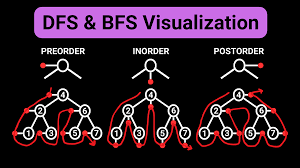
BFS vs DFS Breadth First Search vs Depth First Search
BFS vs DFS (Breadth First Search vs Depth First Search)
BFS (Breadth First Search) and DFS (Depth First Search) are two fundamental graph traversal algorithms used in computer science for searching nodes in a graph or tree structure. Both are widely used in real-world applications such as social networks, navigation systems, AI pathfinding, and web crawling, but they follow completely different strategies.
Core Idea
BFS explores the graph level by level. It starts from a source node and visits all its neighbors first before moving to the next level. This makes BFS ideal when we need the shortest path in an unweighted graph. It uses a queue (FIFO structure) to keep track of nodes.
DFS, on the other hand, explores as deep as possible along one branch before backtracking. It goes deep into a path until it reaches a dead end, then returns and explores another path. DFS uses a stack (LIFO structure) or recursion.
Key Differences Table
| Feature | BFS | DFS |
|---|---|---|
| Traversal Method | Level by level | Depth first (one path deep) |
| Data Structure | Queue | Stack / Recursion |
| Shortest Path | Guarantees shortest path (unweighted graph) | Does not guarantee shortest path |
| Memory Usage | Higher (stores many nodes) | Lower (stores single path) |
| Speed | Slower in deep graphs | Faster in deep traversal cases |
Real World Applications
BFS is commonly used in Google Maps for finding the shortest route, social media friend suggestions, and peer-to-peer networks. DFS is widely used in solving puzzles, topological sorting, maze solving, and detecting cycles in graphs.
Conclusion
BFS is best when we need the shortest path or level-order exploration, while DFS is better when we need deep exploration or backtracking solutions. Both are essential algorithms and choosing between them depends on the problem requirements.